Summary
The Nandini trademark case pitted Karnataka Cooperative Milk Producers Federation Limited, owner of the famous "NANDINI" dairy mark, against Shalimar Agarbatti Company, which sought to register an identical "nandini" label for incense sticks. The Madras High Court set aside the Trade Marks Registry's 2010 rejection of KMF's opposition, holding that the absence of any prefix, suffix or distinctive device in Shalimar's mark made this case materially different from KMF's own 2018 Supreme Court loss over "NANDHINI DELUXE". The ruling matters because it shows how the same underlying word can be both unprotectable in one dispute and infringing in another, depending entirely on how faithfully it is copied.
Background
For a cooperative that has spent over four decades building a household name across two states, a label reading nothing but “nandini” on a box of incense sticks was never going to go unnoticed. The Nandini trademark case has now returned to court, more than a decade and a half after it began, with the Madras High Court holding that a near-identical copy of a famous dairy mark cannot hide behind a generic-name defence when the copying extends to the very way the word is written.
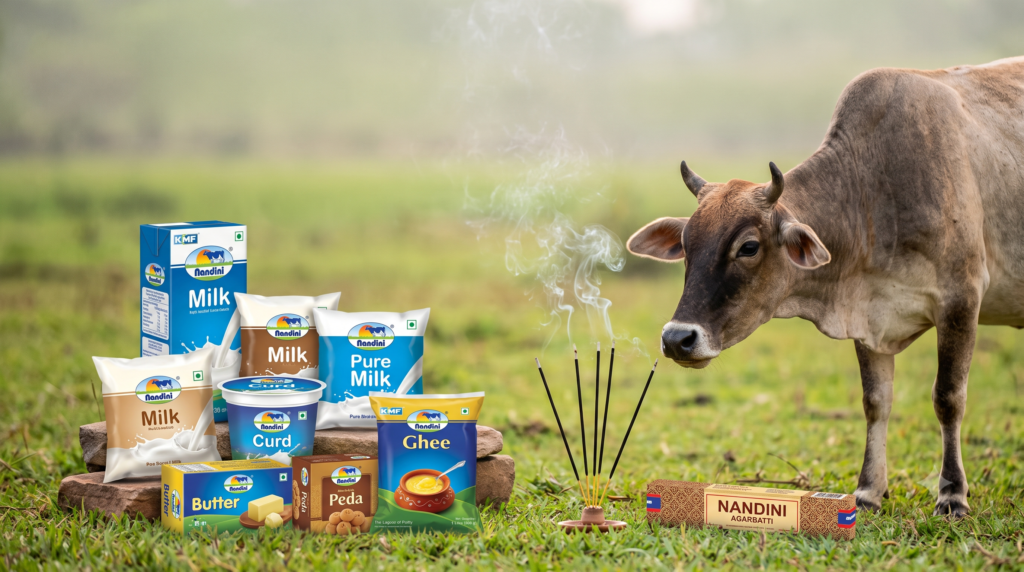
The appeal was filed by M/s. Karnataka Cooperative Milk Producers Federation Limited (“KMF”), the Bengaluru-based federation that has sold milk and milk products under the mark “NANDINI” since 1983 and built it into a household name across Karnataka and neighbouring states. The dispute arose when Vinod Kanji Shah and Nitin Kanji Shah, trading as Shalimar Agarbatti Company (“Shalimar”), applied to register a label mark comprising the word “nandini” for agarbattis and dhoops under Class 3 of the Trade Marks Act, 1999 (“Trade Marks Act”). Shalimar already held a copyright registration for the label since 1985 and a trademark registration, No. 501980, since 1988. KMF opposed the fresh application under Sections 9, 11, 11(a) and 18 of the Trade Marks Act, but the Deputy Registrar of Trade Marks dismissed the opposition on 5 April 2010, holding that “nandini” was a personal name and the name of a Hindu goddess and a cow in mythology, that the goods were unrelated, and that confusion was unlikely. KMF appealed under Section 91 of the Trade Marks Act, first before the erstwhile Intellectual Property Appellate Board and, following its abolition, the appeal was transferred to the Madras High Court and renumbered as (T)CMA(TM).No.112 of 2023.
Issues
-
- Whether the Deputy Registrar of Trade Marks erred in rejecting KMF’s opposition to registration of the “nandini” label mark for agarbattis and dhoops under Sections 9, 11, 11(a) and 18 of the Trade Marks Act.
- Whether the Supreme Court’s ruling in Nandhini Deluxe v. Karnataka Cooperative Milk Producers Federation Ltd., (2018) 9 SCC 183, which rejected KMF’s opposition to a different party’s “NANDHINI DELUXE” mark for restaurant services, barred KMF’s present opposition.
- Whether the phonetic identity and identical stylistic presentation of Shalimar’s mark, as compared to KMF’s registered mark, was sufficient to establish deceptive similarity despite the difference in goods.
KMF’s Arguments
-
- KMF has used the trademark “NANDINI” continuously since 1983 for milk and milk products, has registered the mark, and it has acquired a reputation as a household name in Karnataka and neighbouring states.
- Shalimar’s applied mark reproduces the word “nandini” without any prefix or suffix and in the same lower-case stylistic form as KMF’s own registered mark, unlike the mark considered in the 2018 Supreme Court ruling, which carried the additional word “DELUXE”, a distinct lamp device, and a separate tagline.
- The Deputy Registrar failed to weigh KMF’s acquired distinctiveness and long-standing reputation before treating “nandini” as an unprotectable generic term.
- The near-identical phonetic and visual presentation of the rival mark was likely to deceive a customer familiar with KMF’s reputation, regardless of the difference in goods.
Shalimar’s Position (as recorded before the Registrar)
-
- “Nandini” is a generic term, being the name of a Hindu goddess and of a cow in Hindu mythology, and is not a coined or invented word capable of exclusive appropriation.
- The goods, agarbattis and dhoops, were entirely different from KMF’s milk and dairy products, making confusion unlikely.
- The resemblance between the rival marks was minimal and did not warrant refusal of registration.
- Shalimar did not engage counsel or appear to contest the appeal before the Madras High Court, and the case proceeded on the strength of KMF’s submissions and the record.
Court’s Analysis
Revisiting the 2018 Supreme Court Precedent
The court noted that the Supreme Court’s 2018 ruling in the Nandhini Deluxe case had also involved KMF as the opposing party, this time against a restaurant chain seeking registration of “NANDHINI DELUXE” for foodstuffs. The court observed that the Supreme Court had rejected KMF’s opposition there because “NANDINI”/”NANDHINI” was found to be a generic term rooted in Hindu mythology, because the goods, restaurant food items as opposed to milk products, were dissimilar, and because the rival mark carried distinguishing elements, the suffix “DELUXE”, a lamp device, and the tagline “the real spice of life”, that set it visually apart from KMF’s own mark. The court held that this combination of factors, and not the word “nandini” alone, had driven the outcome in 2018.
Why This Case Was Different
The court reasoned that the presence or absence of such distinguishing elements was the decisive question in the Nandini trademark case now before it. It observed that Shalimar’s applied mark carried no prefix, no suffix and no distinctive device separating it from KMF’s own mark, and that both marks were rendered in the identical stylistic form, entirely in lower case, without ornamentation. The court found that this was “the most important distinguishing feature” from the facts that the Supreme Court had considered in 2018, since that ruling had turned specifically on the presence of such differentiating elements, which were conspicuously absent here.
Deceptive Similarity Despite Different Goods
The court further observed that KMF had built a formidable reputation in the “NANDINI” mark over decades of continuous use, and that a customer well acquainted with that reputation would reasonably be misled by the phonetic identity and identical manner of presentation adopted by Shalimar, irrespective of the difference in the underlying goods. The court opined that the Deputy Registrar had failed to appreciate these crucial aspects while examining the opposition, and had proceeded solely on the finding that “nandini” was a generic mythological term without testing the applied mark against KMF’s specific, registered presentation of that term. The court stated that the manner in which a generic word is stylised and reproduced can itself generate a likelihood of confusion, even where the underlying word, standing alone, might not be capable of exclusive monopoly. Deciding the Nandini trademark case in KMF’s favour, the court held that the Trade Marks Act protects not merely coined words but also the acquired distinctiveness attaching to how a proprietor has used and presented its mark, and that this distinctiveness had been overlooked by the Registrar.
Findings
In view of the observations and the arguments presented by both the parties, the Madras High Court held that:
-
- The Deputy Registrar of Trade Marks had failed to consider the crucial distinguishing aspects between the present dispute and the facts considered by the Supreme Court in the 2018 Nandhini Deluxe ruling.
- The rejection of KMF’s opposition to registration of the “nandini” label mark for agarbattis and dhoops was erroneous and could not be sustained.
- The order dated 5 April 2010 passed by the Deputy Registrar of Trade Marks, rejecting KMF’s opposition, was set aside in its entirety.
- The appeal filed by KMF under Section 91 of the Trade Marks Act was allowed, with no order as to costs.
- The matter stood restored for the Trade Marks Registry to proceed afresh in light of the findings recorded by the court.
Case Citation: M/s. Karnataka Cooperative Milk Producers Federation Limited v. Vinod Kanji Shah & Nitin Kanji Shah, (T)CMA(TM).No.112 of 2023, Madras High Court, decided on 19 January 2026. Available at https://indiankanoon.org/doc/33804808/.
Authored by Gaurav Mishra, IP Attorney, BananaIP Counsels