Summary
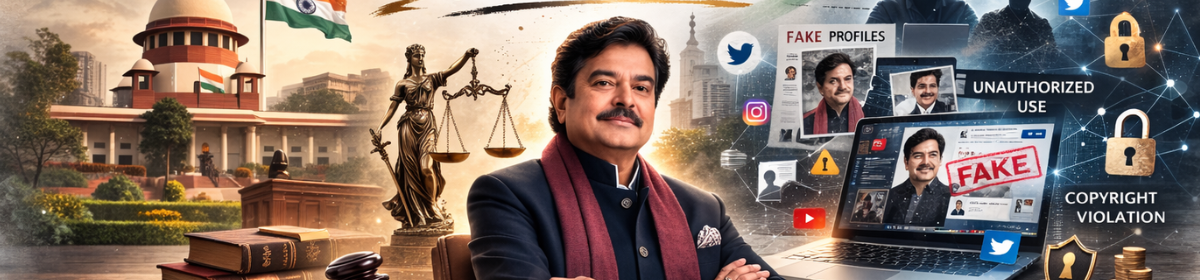
The Shatrughan Sinha digital impersonation case examines the growing misuse of celebrity personas through fake profiles, AI-generated deepfakes, and unauthorized merchandise. The Bombay High Court granted ad-interim relief, reaffirming that personality rights in India protect name, voice, likeness, and distinctive style through passing off and performer’s moral rights.
Background:
The case concerns the protection of personality and publicity rights of veteran actor and public figure Shatrughan Prasad Sinha in the context of increasing digital misuse. An application was moved before the Bombay High Court seeking urgent ad-interim relief against the unauthorized use and commercial exploitation of his identity and persona across various online platforms.
Protection was sought in respect of Shatrughan Prasad Sinha’s name, screen name “Shotgun”, distinctive dialogue delivery style, particularly the expression “Khamosh”, his likeness, voice, performance style, and other identifiable attributes associated with him. It was alleged that fake social media profiles had been created in his name and that digitally manipulated photographs, AI-generated deepfakes, morphed content, memes, GIFs, and even pornographic material had been circulated without consent. It was further alleged that unauthorized merchandise bearing his name and image had been offered for sale on e-commerce platforms for commercial gain.
The Defendants included unidentified persons (John Doe) and various online platforms such as social media, content-sharing, and e-commerce websites. The misuse was broadly described as impersonation through fake profiles, digital manipulation of images and videos, and circulation of AI-generated content. It was observed that sufficient material had been placed on record to consider ex parte ad-interim relief.
Issues:
The following issues arose for consideration:
1. Whether the name, identity, voice, style, and other personal attributes of Shatrughan Prasad Sinha were legally protectable as personality rights.
2. Whether the creation of fake profiles, use of AI-generated and morphed content, circulation of manipulated images, and sale of unauthorized merchandise amounted to infringement of those rights, passing off under trade mark law, and violation of moral rights under copyright law.
3. Finally, the Court had to determine whether a prima facie case was made out for grant of ad-interim injunction.
Arguments by the parties:
On behalf of the Plaintiff, it was submitted that personality rights and moral rights were protected, and reliefs against passing off were sought. It was contended that the Plaintiff was a renowned actor and public figure with substantial goodwill and reputation. It was emphasized that his screen name “Shotgun” and distinctive delivery of the expression “Khamosh” were uniquely associated with him and had become inseparably linked to his persona.
It was further submitted that multiple fake profiles had been created, and that unauthorized memes, GIFs, AI-generated illustrations, deepfakes, morphed images, and pornographic content had been circulated without consent. It was also argued that such acts amounted to commercial exploitation, tarnishment of reputation, and violation of statutory as well as common law rights, including moral rights under Section 38B of the Copyright Act, 1957 and passing off under Section 27(2) of the Trade Marks Act, 1999.
Since the matter was considered at an ex parte stage, no submissions on behalf of the Respondents were recorded in the order.
Analysis and Findings of the Court:
The Court observed that personality rights were protectable elements and that misuse through digital platforms for commercial gain had increased significantly. The Plaintiff’s reputation as a well-known actor and public figure was acknowledged (paragraph 9).
The legal basis for protection was traced to Section 27(2) of the Trade Marks Act, 1999, which preserves the common law remedy of passing off. It was explained that passing off protects a person’s goodwill and reputation from being misused by others in a manner that creates confusion or suggests false association (paragraph 10).
The Court also referred to Sections 2(qq) and 38B of the Copyright Act, 1957. Section 2(qq) defines a “performer”, and Section 38B grants moral rights to performers, including the right to be identified with their performance and to object to any distortion or modification that may harm their reputation (paragraph 10).
Further, reliance was placed on the decision in Arun Jaitley v. Network Solutions Private Limited & Ors. (2011 SCC OnLine Del 2660), where it had been observed that a distinctive personal name, which has acquired reputation and goodwill, may be protected under the principles of passing off. Applying this reasoning, it was observed that the name of Shatrughan Prasad Sinha had acquired distinctiveness and commercial value, and therefore fulfilled the criteria for protection similar to that of a trade mark (paragraph 10).
It was ruled that the unauthorized sale of merchandise amounted to passing off, as it falsely suggested association and commercially exploited the goodwill attached to the name of Shatrughan Prasad Sinha. It was further stated that AI-generated and digitally altered content violated the moral rights of a performer under Section 38B of the Copyright Act, 1957, since such distortion could harm reputation. The Court clarified that personality rights include the exclusive right to control the commercial use of one’s name, image, voice, and identity (paragraph 14 and 15).
A prima facie finding was recorded that the personality rights and privacy of Shatrughan Prasad Sinha had been infringed and deserved protection. An ad-interim injunction was therefore granted restraining further misuse of his name, image, voice, and other attributes, including through AI and deepfakes, and certain platforms were directed to disclose details of the infringers. The protection was to continue until the next date of hearing (paragraph 16-19).
Shatrughan Prasad Sinha v. John Doe & Ors., Interim Application (L) No. 2870 of 2026 in Commercial IP Suit (L) No. 2167 of 2026, slip op. (Bom. H.C. Feb. 16, 2026).
Authored by: Ms. Ananya Nadajoshi and reviewed by Ms. Sowmya S. Murthy