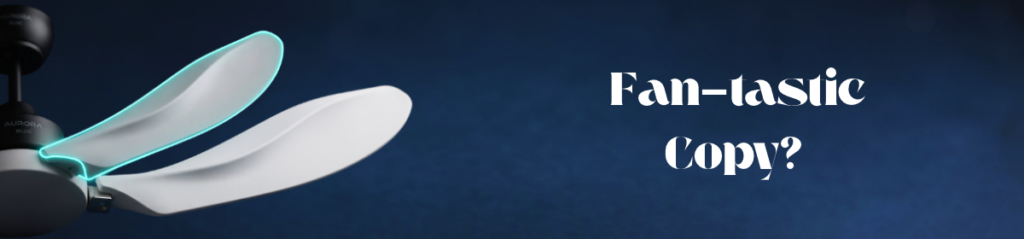
Summary
Atomberg Technologies Private Limited sued Stove Kraft Limited, alleging that the Pigeon Fan-tastic BLDC ceiling fan copied the registered design of its Renesa Alpha fan. A Single Judge of the Bombay High Court refused interim relief and discharged the Court Receiver. On appeal, the Division Bench held that the registered design must be judged by its overall visual appearance, centred on the petal-shaped blades, and not by an unclaimed feature such as the shank. The ruling restores the injunction and clarifies how the eye test operates when a design is applied across several product variants.
Background
A ceiling fan with petal-shaped blades, registered as a design in January 2020, met a rival fan on the market five years later, and the Bombay High Court Division Bench had to decide whether the trial court looked at the right features before refusing interim relief.
Atomberg Technologies Private Limited (“Atomberg”) holds Registration No. 325322-001 in Class 23-04 under the Designs Act, 2000 (“Designs Act”), dated 1 January 2020, for its Renesa Alpha ceiling fan. Atomberg conceived the design in 2019, has sold fans carrying it since November 2020, and applied the same design to five variants: Renesa Prime, Prime Regulator, Zen, Enzel and Prime Remote. Stove Kraft Limited (“Stove Kraft”) adopted its Pigeon Fan-tastic BLDC Ceiling Fan in February 2025 and filed its own design application on 21 February 2025. Atomberg then filed Commercial (IP) Suit No. 710 of 2025, seeking a permanent injunction, Rs. 110 crore in damages or an account of profits, alleging design infringement and passing off. This Atomberg design infringement dispute produced an ex parte ad-interim order on 24 July 2025 that restrained Stove Kraft and appointed a Court Receiver to take control of the impugned fans. On 17 April 2026, a Single Judge refused the temporary injunction, discharged the Court Receiver and ordered the seized goods released. Atomberg appealed. The Division Bench reserved judgment on 27 July 2026 and pronounced it on 16 October 2026.
Issues
-
- Whether the Single Judge erred in comparing Atomberg’s registered design with Stove Kraft’s fan by reference to the Z-shaped shank, a feature Atomberg did not claim as novel under Section 2(d) of the Designs Act.
- Whether the registered design could be assessed across all six Renesa variants instead of the Renesa Alpha alone.
- Whether the average consumer with imperfect recollection or the informed user is the yardstick for piracy under Section 22 of the Designs Act at the interim stage.
- Whether functionality of the blade shape is a defence to design infringement.
- Whether Atomberg established goodwill and a likelihood of confusion for passing off, and whether the ad-interim order and the Court Receiver should be restored.
Atomberg’s Arguments
-
-
- Novelty lay in the overall shape and configuration, namely petal-inspired blade curves with a continuous surface, asymmetric blade tapering, a fillet at the blade-narrowing junction, a subtle V-bend along the blade, a body narrowing at the top and widening below, and a canopy with a slanted top edge.
- The design was registered once and applied to six variants, so all six form part of the same registered design for comparison under Sections 2(d), 2(g) and 22 of the Designs Act.
- Stove Kraft offered no explanation for how it conceived its design and produced no prior art showing the claimed combination already existed.
- The Bombay average purchaser test governs, and the narrower Delhi informed-user line does not apply.
- Sales from November 2020 to April-May 2025, backed by a chartered accountant’s certificate, established goodwill for passing off.
-
Stove Kraft’s Arguments
-
-
- Interference with an interlocutory discretion is limited to orders that are arbitrary, capricious or perverse, as laid down in Wander Ltd v. Antox India (1990 Supp SCC 727).
- A design is not a source identifier and sits closer to copyright than to trade mark law, so the trade mark test of imperfect recollection does not apply. An informed user with an instructed eye must make the comparison.
- Only the registered design should be compared, not the later variants, and the Z-shaped shank, absent from Stove Kraft’s fan, was the real novelty.
- Fraudulent imitation requires a side-by-side comparison of essential features, and the shank, canopy and motor housing differ.
- The chartered accountant’s certificate covered six models and did not show goodwill in the specific design.
-
Court’s Analysis
Petals, Not Shanks: What the Registration Protects
The court noted that the registration certificate covers the design as applied to a ceiling fan, and that Atomberg applied that design across six models. It reasoned that comparison with the variants was therefore permissible, because they carry the same registered design. The court further observed that Atomberg claimed novelty in the combination of shape and configuration, so the Z-shaped shank, which Atomberg never claimed and which is invisible once the fan is hung, could not decide the case.
The court held that the essential novelty lies in the blades. On a side-by-side comparison, it found the blade design prima facie identical in angle, length and curvature. It treated the differences in shank profile, canopy shape and motor housing as minor, and noted that the top and bottom views of both fans showed striking similarity. This is the heart of the Atomberg design infringement finding: a design is judged as a whole, and minute or isolated differences cannot dissect it.
Whose Eye Counts
The court observed that the test for novelty, originality and piracy under the Designs Act is the eye alone, applied from the standpoint of a purchaser. It stated that design appeals to the heart rather than the head, and it applied the average consumer test of imperfect recollection, finding that a buyer would be misled by the blade shape. The court noted Stove Kraft’s reliance on the Delhi informed-user decisions but proceeded on the Bombay approach, and it recorded that registration is article specific and that piracy occurs when the features giving a design its aesthetic value are copied.
The court found that functionality offers no shield. It reasoned that the test concerns aesthetic appeal, and a fan can perform its function through blades of other shapes. The court further observed that Stove Kraft produced no prior art showing that the claimed combination of features already existed, which weighed against it in this Atomberg design infringement analysis.
Goodwill and the Risk of Confusion
The court held that Atomberg had shown goodwill and reputation through a chartered accountant’s certificate, representative invoices, promotional material and sales figures. It found that both fans target the same class of consumers and can be sold through overlapping channels, including online platforms. The court opined that a purchaser could take Stove Kraft’s fan for an Atomberg product, a variant of it, or a commercially associated product, and that actual confusion need not be proved because likelihood suffices. The court reasoned that Stove Kraft’s adoption was likely to divert sales and erode goodwill, which justified interim protection and the restoration of the Court Receiver.
Findings
In view of the observations and the arguments presented by both the parties, the Bombay High Court Division Bench held that:
-
-
- The Single Judge erred by giving weight to the unclaimed Z-shaped shank instead of the registered design’s overall appearance, centred on the petal-shaped blades.
- The registered design applies across all six Renesa variants, and comparison with those variants is permissible.
- Stove Kraft’s fan is prima facie visually similar to the registered design, and functionality is not a defence.
- Atomberg established goodwill and a likelihood of confusion, which supports its passing off claim at the interim stage.
- The appeal is allowed and the order of 17 April 2026 is set aside.
- The ad-interim order of 24 July 2025 is restored, including the appointment of the Court Receiver.
- Stove Kraft is restrained, until final disposal of the suit, from infringing the registered design and from manufacturing, selling, marketing, exporting, distributing, exhibiting or advertising fans identical or deceptively similar in shape, configuration or design.
-
Case Citation: Atomberg Technologies Private Limited v. Stove Kraft Limited, Commercial Appeal (L) No. 14941 of 2026 in Interim Application No. 88 of 2026 in Commercial (IP) Suit No. 710 of 2025, Bombay High Court, decided on 16 October 2026. Available at http://indiankanoon.org/doc/42716658/
Authored by Gaurav Mishra, Patent and Design Attorney, BananaIP Counsels