Summary
On 16 October 2026, the Office of the Controller General of Patents, Designs and Trade Marks published the Draft Guidelines on Use of Artificial Intelligence in Proceedings before the Trade Marks Registry for stakeholder comments, following the directions of the Hon'ble High Court of Delhi in Stryten Energy LLC v. Nidhi Agarwal & Ors. In their comments, the Trademark and Patent Attorneys at BananaIP Counsels suggest that AI be viewed as another technology used by attorneys, and that the guidelines place the emphasis on the duty of verification and the accuracy of submissions, rather than on the tools used to prepare them. Referring to the approach of the USPTO and the EPO, neither of which requires attorneys to declare the use of AI, the comments recommend deleting the mandatory declaration of AI use, the treatment of non-disclosure as misrepresentation, and the powers of the Registrar to take action and review submissions, so that any action is taken under the applicable law. The comments also suggest specific changes to the provisions on commencement, verification, recognised legal sources, affidavits and secure systems for the official use of AI, and identify the provisions that may be retained.
Note: These comments were formally submitted to the IP Office on 5th November, 2026, by the Trademark and Patent Attorneys at BananaIP Counsels, in response to Public Notice No. CG/F/CGPDTM/DL-10/4908 dated 16 October 2026. The draft of the comments is being shared below as submitted to CGPDTM.
Introduction
The Trademark and Patent Attorneys at BananaIP Counsels are pleased to submit their comments and recommendations on the Draft Guidelines on Use of Artificial Intelligence in Proceedings before the Trade Marks Registry (the draft guidelines), published by the Office of the Controller General of Patents, Designs and Trade Marks (the IP Office) along with its Public Notice dated 16 October 2026. The attorneys have been filing and prosecuting trade mark applications, and representing clients in opposition, rectification and other proceedings before the Trade Marks Registry, for over two decades. The comments in this document are based on that experience, on a study of the draft guidelines, and on a review of comparable guidance issued by the United States Patent and Trademark Office (USPTO) and the European Patent Office (EPO).
Background
On 16 October 2026, the Office of the Controller General of Patents, Designs and Trade Marks issued the Draft Guidelines on Use of Artificial Intelligence in Proceedings before the Trade Marks Registry for stakeholder comments. These guidelines were issued in furtherance of the directions of the Hon’ble High Court of Delhi in the case of Stryten Energy LLC v. Nidhi Agarwal & Ors., W.P.(C)-IPD 16/2026, Order dated 13 October 2026. The Trademark and Patent Attorneys at BananaIP Counsels are hereby submitting these comments and observations with respect to the guidelines.
Guidelines in the United States and Europe for IP Attorneys
Earlier, to address the use of AI by attorneys, the United States Patent and Trademark Office (USPTO) issued guidance on the use of AI tools in practice before it in April 2024. Rather than creating new obligations, the guidance explains how the existing rules apply when AI is used, and in doing so, it covers the duty of candour, the signature requirement and the certification that comes with it, confidentiality of client information, export controls, and the use of AI in drafting and filing documents. Central to all of these is the duty of the person presenting a paper to review and verify its contents, including facts, citations and legal arguments, and the guidance makes it clear that relying on an AI tool is not a reasonable inquiry. The same duty is applied to trademark practice, where AI assisted submissions must be carefully reviewed for truth and evidentiary support, and AI generated specimens that do not show actual use of a mark must not be filed. Having placed this responsibility on the person who files, the guidance states that there is no general duty to inform the USPTO that an AI tool was used in drafting a paper, unless the USPTO specifically asks for that information. Disclosure is, therefore, required only in limited cases, such as patent matters where the use of AI is material to patentability (USPTO, 2024, sections II and III.A).
The European Patent Office (EPO) has taken a similar approach in its Guidelines for Examination, 2026. According to the Guidelines, parties are responsible for the content of their applications and submissions, and for compliance with the European Patent Convention and the Patent Cooperation Treaty, regardless of whether a document was prepared with the help of AI. Since the responsibility remains with the party in every case, the Guidelines do not ask parties or their representatives to declare the use of AI (EPO, 2026, General Part, section 5). It follows that neither the USPTO nor the EPO requires attorneys to make a routine declaration of AI use of the kind proposed in the draft guidelines. Instead, both place responsibility on the person who files, and rely on review, verification and the existing duties of candour to ensure it.
The guidelines referred to above are available at the following links:
- USPTO, Guidance on Use of Artificial Intelligence-Based Tools in Practice Before the United States Patent and Trademark Office (Federal Register, 11 April 2024)
- EPO, Guidelines for Examination 2026, General Part, section 5, The use of artificial intelligence
Comments and Suggestions
General Comments
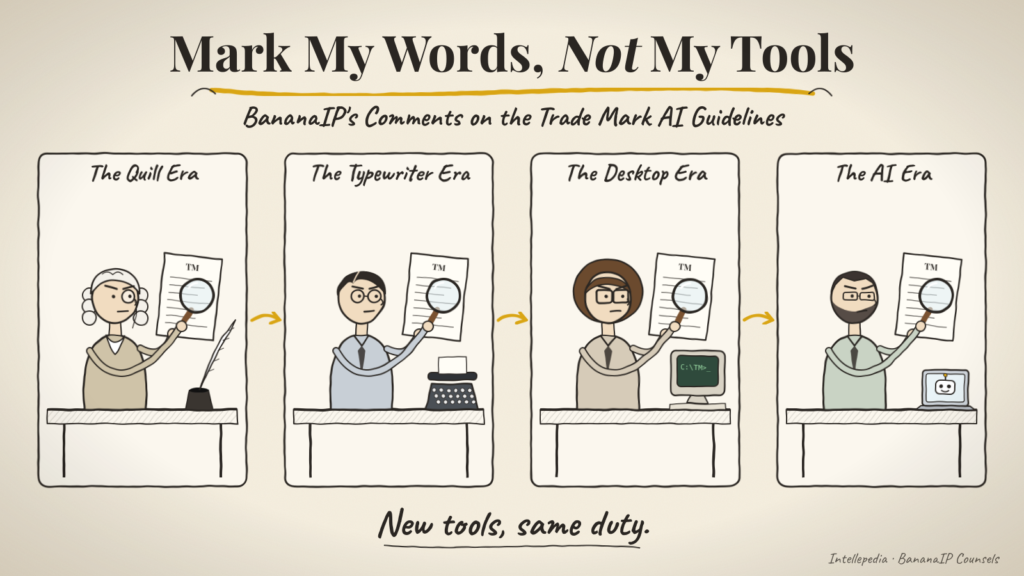
As AI is being extensively used in all professions, including by IP attorneys, guidance on its use in proceedings before the Trade Marks Registry is required. Such guidance, however, must be viewed in the context of two aspects. First, attorneys who sign or file documents before the Registry already have a general duty to ensure that everything they submit is accurate and correct, and this duty does not change with the tools they use to prepare those documents. Second, AI is a technology like any other, albeit relatively more capable than traditional software, and attorneys use it to assist and aid them in their work, in the same way as they have used word processors, research databases, mobile devices and other technologies over the years.
In this context, AI must be viewed by the IP Office as another technology used by attorneys, and the emphasis must be on the duty of verification and on the accuracy of the documents they submit. Any additional requirement, such as the submission of declarations, disclosures or other documents relating to the use of AI, is not required, since it adds nothing to the accuracy of what is filed, and it will make the process burdensome for all stakeholders. Such requirements will also affect the trade mark process, as every filing will carry an additional formality, and they may complicate opposition and other inter partes proceedings, where disputes over declarations may arise in addition to disputes on the merits.
In line with this thinking, the USPTO and the EPO have placed the responsibility for a submission on the person who files it, required that person to review and verify its contents, and refrained from seeking a general declaration of AI use. Similarly, the Indian IP Office may also limit its guidelines to the duty of verification and the accuracy of documents, without requiring declarations or disclosures of AI use.
Recommendations
In the said context, the following parts of the draft guidelines may be done away with, and the guidelines may be limited to the duty of verification and the accuracy of documents:
- The mandatory disclosure declaration of AI use under Clause 5.1.
- The absolute obligation of disclosure, and the treatment of non-disclosure as misrepresentation, under Clause 5.2.
- The mandatory declaration of AI use, and its signing and verification, under Clause 8.
- The applicability and scope of the declaration requirement under Clause 10.
- The declaration form prescribed under Annexure I.
- The grounds for action, and the powers of the Registrar to initiate proceedings, strike off submissions and refer attorneys and agents for disciplinary action, under Clause 12.
- The review of reported submissions by the Registrar under Clauses 13.2 to 13.4, and the references to declarations in Clause 13.1(c) and Annexure II.
Any action against attorneys or applicants may instead be taken under the applicable legal provisions and the disciplinary proceedings that already govern their conduct.
Specific Comments and Suggestions
1. Commencement and Application to Pending Proceedings (Clause 1.2)
Comment
Clause 1.2 provides that the guidelines will come into force on notification and will apply to all proceedings, pending as well as new. Submissions in pending proceedings have been prepared and filed on the basis of the law as it stood at the time. Applying new obligations to them may raise doubts about whether such submissions need to be revisited or supplemented, and this would add to the burden on attorneys and on the Registry alike.
Recommendation
Clause 1.2 may be modified so that the guidelines apply to submissions filed on or after the date of notification, whether the proceedings are pending or new. The clause may read as follows:
“1.2 These Guidelines shall come into force on the date of their notification by the Office of the Controller General of Patents, Designs and Trade Marks, and shall apply to submissions filed on or after that date in all proceedings, whether pending or hereafter initiated, before the Trade Marks Registry across all offices of the Registry in India.”
2. Verification Irrespective of the Technology Used (Clauses 6 and 9)
Comment
Clauses 6 and 9 require verification of case law citations, statutory provisions, legal propositions and material facts only where they have been “generated or contributed by any AI”. As explained in the General Comments, attorneys already have a duty to ensure that everything they submit is accurate, whether a document is prepared with AI, with other software, or without any tool. Linking the duty of verification to the use of AI would, therefore, make AI use a relevant question again, which the deletion of the disclosure requirement seeks to avoid. The draft itself recognises this principle in Clause 9.3, which makes a non-existent or misleading citation a ground for action regardless of whether it originated from AI.
Recommendation
The words “that has been generated or contributed by any AI” and similar words may be deleted from Clauses 6.1, 6.2, 9.1 and 9.2, so that the duty of verification applies to all content of a submission, irrespective of the technology used to prepare it. Clause 6.1 may, for instance, read as follows:
“6.1 Every case law citation, statutory provision, rule, and legal proposition contained in a Submission shall be independently verified through Authorised and Recognised Legal Sources, as defined in Clause 3(k), prior to submission, irrespective of the tools or technology used in its preparation.”
3. Authorised and Recognised Legal Sources (Clause 3.1(k))
Comment
Clause 3.1(k) lists the sources against which material must be verified. The list is limited to Indian sources, namely the websites of the Supreme Court and High Courts, the Official Gazette, certified copies, established Indian law reports and databases, and the Registry’s portal. These sources must also be accessed “without reliance on the output of an AI”. Trade mark proceedings, however, often rely on foreign judgments, decisions of foreign IP offices and international materials, which are not covered by the list. Further, many established legal databases now include AI-based search and summary features, and the present wording may create doubt about whether using such features is permitted, even where the attorney reads the full text of the judgment.
Recommendation
Clause 3.1(k) may be modified as follows:
- Include the official websites of foreign courts, foreign IP offices and international organisations, and other reliable legal databases, among the recognised sources.
- Clarify that AI-based search and other features within recognised sources may be used, provided the full text of the material relied upon is read and verified from the source.
4. Affidavits and Declarations (Clause 14.1)
Comment
Clause 14.1 provides that no AI shall be used to “generate, author, embellish, strengthen, dilute, fabricate, or otherwise alter” the substantive content of an affidavit or declaration. The concern behind the clause is valid, since the facts stated in an affidavit must come from the personal knowledge of the deponent. In practice, however, attorneys routinely draft affidavits on the basis of the instructions and documents provided by the deponent, and AI, like other software, may assist in organising and expressing those facts. As worded, the bar on using AI to “author” content would extend to such drafting assistance, even where every fact has been provided and verified by the deponent.
Recommendation
Clause 14.1 may be modified so that the bar applies to fabricating, embellishing or altering facts, and not to drafting assistance. The clause may read as follows:
“14.1 No AI shall be used to fabricate, embellish, strengthen, dilute or otherwise alter the facts stated in any affidavit, declaration, verification, undertaking, or statement intended to represent the personal knowledge, belief, opinion, affirmation, or verification of a deponent or declarant. AI may be used to assist in drafting or formatting such documents, provided that the deponent or declarant has verified and affirmed every statement of fact contained in them.”
5. Secure Systems for Official Use of AI (Clause 11.3)
Comment
Clause 11.3 provides that the Controller General “may” prescribe additional safeguards, approved AI systems, verification protocols and security standards for the official use of AI within the Registry. Officers of the Registry handle evidence, personal data and confidential business information filed by applicants. The protection of such material should not depend on the choice of AI tools made by individual officers.
Recommendation
In Clause 11.3, the word “may” may be replaced with “shall”, so that approved AI systems, verification protocols and security standards for official use are prescribed in every case.
6. Provisions that May Be Retained (Clauses 4, 7 and 9.1)
Comment
Several provisions of the draft reflect the approach suggested in these comments:
- Clause 4 keeps the use of AI subservient to human judgment, and makes it clear that no person can avoid responsibility by attributing an error to AI.
- Clause 7 recognises the duty of candour that attorneys owe to the Registry.
- The proviso to Clause 9.1 ensures that no action lies merely because the relevance of a cited case is disputed.
Recommendation
These provisions may be retained, as they place the emphasis on human responsibility and the accuracy of submissions.
Conclusion
AI is a technology that attorneys use to assist them in their work, and the guidelines will serve their purpose best if they focus on the duty of verification and the accuracy of documents filed before the Registry. With the changes suggested above, the guidelines would protect the integrity of trade mark proceedings without adding to the burden on applicants, attorneys and the Registry. The Trademark and Patent Attorneys at BananaIP Counsels would be happy to provide any clarification or give a presentation on these comments.
Accessible Version of Guidelines
An accessible version of the Draft Guidelines on Use of Artificial Intelligence in Proceedings before the Trade Marks Registry, prepared for screen reader use, can be downloaded at this link: Draft TM AI Guidelines, Accessible Version (Word document).
Limitation and Disclaimer
The comments and suggestions in this document are based on the experience and understanding of the Trademark and Patent Attorneys at BananaIP Counsels, and they are not generalisations. Other experts may hold different views, and the suggestions made in this document are not the only ways of addressing the issues raised. The views expressed in this document do not reflect the views of the clients of BananaIP Counsels. AI tools were used in preparing this document only to refine the language, correct grammar, make the document accessible and verify sources, and the comments and proposals remain the original work of the attorneys. The comments have been submitted with a bona fide and honest intent of assisting the IP Office in framing comprehensive and workable guidelines.