Summary
Philip Morris Products S.A. filed eight appeals before the Delhi High Court against orders by the Controller of Patents refusing patent applications for aerosol-generating and nicotine delivery devices under Section 3(b) of the Patents Act, 1970. The Controller had relied primarily on the ban imposed by the Prohibition of Electronic Cigarettes Act, 2019 and reports by the WHO and ICMR to conclude that the inventions were inherently harmful to human health. The court remanded all eight applications, holding that Section 3(b) requires a specific, scientific analysis of each invention's primary intended use, and that the mere fact that an invention relates to tobacco, nicotine, or aerosol-generating devices cannot, per se, ground a refusal. The ruling also reinforced that the ENDS Act governs commercialisation, not patent grant, and that a patent does not confer any right to sell or manufacture the patented product.
Background
Eight patent applications, multiple refusal orders, and a single consolidated ruling: the Delhi High Court’s April 2026 decision in Philip Morris’s batch of appeals redraws the boundary between public health policy and Section 3(b) of the Patents Act, 1970 (“Patents Act”) with rare clarity.
Philip Morris Products S.A. (“Philip Morris”), a Swiss multinational operating in the tobacco and nicotine delivery space, filed multiple patent applications in India between 2014 and 2021 covering a range of innovations: a flavoured nicotine powder inhaler that mimics the inhalation rate of conventional smoking, an aerosol-generating article with a dual-material susceptor for contactless temperature control, a tobacco-free aerosol-generating film for use as a substrate, an aerosol-cooling element for heated tobacco articles, a cartridge-mounted atomiser assembly with protected electrical contacts, a temperature-responsive control mechanism for aerosol-generating devices, an aerosol-forming substrate for inductive heating systems, and a method of producing tobacco cut filler with improved filling power using reconstituted tobacco. Each application completed the examination cycle: a First Examination Report (“FER”) was issued, Philip Morris filed its replies, a hearing took place, and post-hearing written submissions were filed. In each case, the Controller or Assistant Controller of Patents and Designs (“Controller”) passed a refusal order under Section 15 read with Section 3(b) of the Patents Act, holding that the primary or intended use of the invention would cause serious prejudice to human life or health. The Controllers relied heavily on the Prohibition of Electronic Cigarettes (Production, Manufacture, Import, Export, Transport, Sale, Distribution, Storage and Advertisement) Act, 2019 (“ENDS Act”) and on reports by the World Health Organization (“WHO”) and the Indian Council of Medical Research (“ICMR”). Philip Morris filed eight separate appeals before the Delhi High Court under Section 117A of the Patents Act; all were heard and decided together on April 17, 2026.
Issues
-
-
- Whether the impugned orders in C.A.(COMM.IPD-PAT) 6/2024 and C.A.(COMM.IPD-PAT) 28/2024 violated the principles of natural justice, where the Controller cited nine documents for the first time in the refusal orders without raising them in the FER or hearing notice.
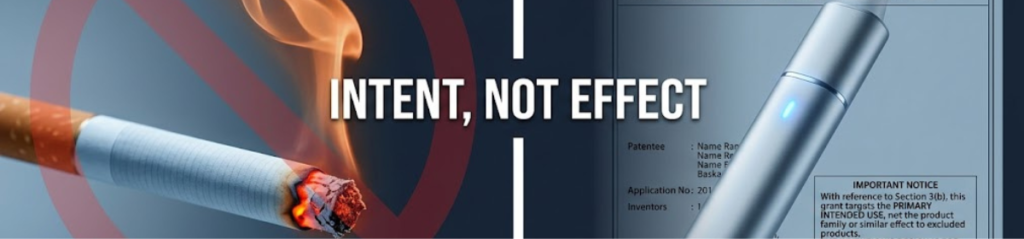
- Whether Section 3(b) of the Patents Act operates on an “intent principle” (primary or intended use of the specific claimed invention) or an “effect/harm principle” (general harmfulness associated with the technical field).
- Whether the ENDS Act’s commercial ban on electronic cigarettes can independently ground a refusal under the Patents Act.
- Whether an invention relating to aerosol-generating devices, heat-not-burn technology, or nicotine is per se non-patentable under Section 3(b).
-
Philip Morris’s Arguments
-
-
- In two appeals (C.A. 6/2024 and C.A. 28/2024), the Controller relied for the first time in the impugned orders on nine published documents, none of which featured in the FERs or hearing notices, depriving Philip Morris of any opportunity to contest them.
- The Patents Act is a complete code for patent examination; patentability cannot be decided on the basis of government policies, ministerial advisories, or other statutes except as expressly provided (the only express exception being Section 4, which covers atomic energy inventions).
- Section 3(b) targets the “primary or intended use or commercial exploitation” of the specific claimed invention: a component, sub-system, or technical improvement cannot be refused merely because the broader product ecosystem involves nicotine or tobacco.
- Nicotine Replacement Therapies are recognised and approved by the US FDA for smoking cessation; the Ministry of Health and Family Welfare includes Nicotine Replacement Therapy under its national list of medicines for psychoactive substance disorders, confirming that nicotine has medicinal applications.
- A patent confers a negative right under Section 48 of the Patents Act: it gives the patentee the right to exclude third parties from using the invention; it does not authorise manufacture, sale, or commercialisation, which remains subject to all applicable domestic laws including the ENDS Act.
- Article 4quater of the Paris Convention and Article 27(2) of the Agreement on Trade-Related Aspects of Intellectual Property Rights (“TRIPS”) confirm that a product’s commercial ban cannot alone ground refusal of a patent.
- Corresponding patents for the same inventions have been granted in the US, Canada, Japan, and other jurisdictions.
-
Controller’s Arguments
-
-
- Inventions directed to aerosol-generating devices fall within Section 3(b) because their primary use is to deliver nicotine or tobacco aerosol into human lungs, which is inherently harmful.
- The ENDS Act reflects Parliament’s determination that electronic cigarettes are harmful; that legislative judgment should inform the Controller’s Section 3(b) analysis and amounts to evidence of public policy against these inventions.
- WHO and ICMR reports establish that nicotine, regardless of delivery mechanism, is highly addictive and causes serious harm to multiple biological systems.
- Grant of patents in other jurisdictions is irrelevant; each country applies its own patentability standards and patent titles in foreign grants indicate those inventions relate to conventional cigarettes, not e-cigarettes.
-
Court’s Observations and Analysis
Natural Justice cannot be sidestepped in Patent Proceedings
The court observed that in C.A. 6/2024 and C.A. 28/2024, the nine documents first cited in the refusal orders had not appeared in any FER or hearing notice issued to Philip Morris. Relying on Otsuka Pharmaceutical Co. Ltd. v. Controller of Patents (2022 SCC OnLine Del 4982), the court noted that the fundamental principle of natural justice, that no person may be condemned unheard, applies with full force to patent examination proceedings. The court held that all objections and documents on which the Controller intends to rely must be communicated to the applicant before the hearing, giving the applicant a meaningful opportunity to respond. No new grounds may be introduced for the first time in the final order. On this ground alone, those two appeals merited being set aside.
Section 3(b) is governed by the Intent Principle, Not the Harm Principle
Turning to the substantive question common to all eight appeals, the court reasoned that Section 3(b) of the Patents Act targets the “primary or intended use or commercial exploitation” of the claimed invention, not the general category of technology to which an invention belongs. The court held that merely because an invention pertains to an aerosol-generating substance or device, or to tobacco or nicotine, cannot per se constitute a ground to deny patent protection. The court further observed that a Controller refusing an application under Section 3(b) must carry out a specific, scientific analysis of the claimed invention and must demonstrate, with cogent material in the refusal order itself, why the primary intended use of that particular invention would cause serious prejudice to human, animal, or plant life or health or to the environment. A preconceived notion that the technical field is harmful does not satisfy this requirement. The court noted that none of the impugned orders contained such an analysis: the Controllers had rejected the applications under the influence of the singular fact that the inventions pertain to aerosol-generating substrates or devices and to nicotine or tobacco, without engaging with the technical contribution of each claimed invention.
The ENDS Act governs Commerce, Not Patents
The court stated that the ENDS Act regulates the production, manufacture, import, export, transport, sale, distribution, storage, and advertisement of electronic cigarettes. It does not address the grant of patents for inventions in this space. The court observed that the Patents Act contains no provision authorising the Controller to refuse a patent on the basis of a separate statute’s commercial prohibitions, apart from the express carve-out in Section 4 for atomic energy inventions. The court noted that relying on the ENDS Act as a ground for refusal under Section 3(b) rests on a fundamental misreading of both statutes. In this regard, the court drew on ITC Limited v. The Controller of Patents, Designs and Trademark (MANU/WB/1167/2025), where the Calcutta High Court had squarely held that the ENDS Act deals with sale, manufacture, import, and export, and not with the grant or non-grant of a patent for an invention.
A Patent is a Right to Exclude, Not a Licence to Sell
The court found that the impugned orders proceeded on a legally unsound premise: that granting a patent automatically confers on the patentee the right to manufacture and commercialise the patented product. The court observed that a patent is, historically and statutorily, a negative or exclusionary right: it gives the patentee the right to prevent third parties from using the invention without permission, not a licence to exploit it commercially. Commercial exploitation of any patented product remains subject to all applicable domestic laws, including the ENDS Act. Refusing a patent application on the ground that the commercial exploitation of the product is prohibited is therefore misconceived and contrary to the structure of Section 48 of the Patents Act.
Foreign Grants are persuasive, especially on Health Questions
The court further observed that while patent grants in foreign jurisdictions are not binding on the Indian Controller, they carry persuasive weight, especially when the question under consideration concerns the harmful effects of the claimed invention on human health. The court reasoned that if an invention has been patented in multiple jurisdictions, it has, in effect, been assessed as not primarily intended to cause harm to human health in those territories. The court noted that the Controllers remained entirely oblivious of these foreign grants, and held that a reasoned, independent analysis must engage with this material, particularly on policy-sensitive questions involving public health.
Findings
In view of the observations and the arguments presented by both the parties, the Delhi High Court held that:
-
-
- In C.A.(COMM.IPD-PAT) 6/2024 and C.A.(COMM.IPD-PAT) 28/2024, the impugned orders violate principles of natural justice because nine documents were cited in the orders without having been disclosed in the FER or hearing notice, and Philip Morris had no opportunity to rebut them.
- Section 3(b) of the Patents Act operates on an intent principle: the Controller must first identify the primary or intended use of the specific claimed invention, and then establish through scientific reasoning that this use causes serious prejudice to human, animal, or plant life or health or to the environment.
- The mere fact that an invention relates to aerosol-generating devices, heat-not-burn technology, tobacco, or nicotine cannot, per se, ground a refusal under Section 3(b).
- The ENDS Act deals with commercialisation and does not govern the grant of patents; it cannot independently ground a refusal under the Patents Act.
- A patent is a negative right and confers no right to manufacture, sell, or commercialise the patented product; refusal premised on the assumption that patent grant authorises commercial exploitation is legally unsound.
- Non-speaking and unreasoned orders cannot be sustained on first principles of administrative and patent law.
- All eight impugned orders are set aside, and the matters are remanded to the Controller for fresh consideration, with directions to pass reasoned, speaking orders after giving Philip Morris a full opportunity to be heard on all grounds and after considering all relevant material, including foreign patent grants.
-
Case Citation: Philip Morris Products S.A. v. Deputy Controller of Patents and Designs and Connected Matters, C.A.(COMM.IPD-PAT) 6/2024, 40/2024, 49/2024, 61/2024, 79/2024, 28/2024, 32/2024 and 27/2025, High Court of Delhi, decided on April 17, 2026. Available at http://indiankanoon.org/doc/54574049/
Authored by Gaurav Mishra, Patent Attorney, BananaIP Counsels
