Summary
In the case of IndiaMart InterMesh Limited v. OpenAI Inc. and Others, the Calcutta High Court refused interim relief to IndiaMart, which had claimed that ChatGPT deliberately excluded IndiaMart links while showing links from other platforms. The court held that IndiaMart had not shown a legal right requiring ChatGPT to display its website or seller listing links in the manner desired by IndiaMart. The court also prima facie treated ChatGPT as an originator under the Information Technology Act, 2000, while leaving the final question for trial.
Background
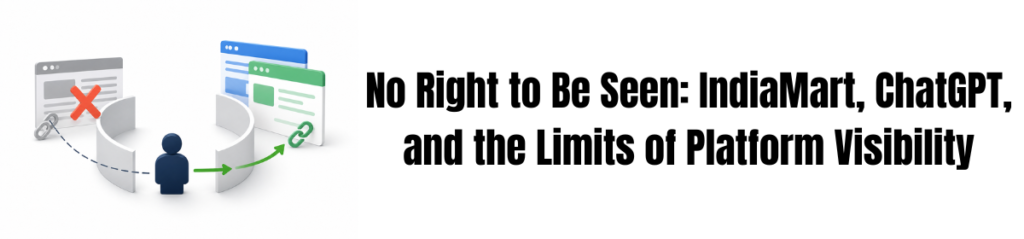
Generative AI and Platform Visibility Dispute IndiaMart operated an online business to business platform and relied heavily on internet traffic, search visibility, and links to its website. It alleged that when users made product queries relating to IndiaMart, ChatGPT bypassed IndiaMart links and directly showed seller websites or other sources. According to IndiaMart, this deprived it of prospective traffic and affected its business.
IndiaMart further alleged that OpenAI had refused to display its content because IndiaMart appeared on the United States Trade Representative Review of Notorious Markets List 2024. IndiaMart argued that the list had no legal force in India and that OpenAI had relied on it unfairly and selectively.
OpenAI resisted the application. It argued that IndiaMart had no right to visibility on ChatGPT, that ChatGPT was not bound to display IndiaMart links, and that the claim sought to dictate how a private technology platform should operate.
Questions Before the Court
- Whether IndiaMart had a legal right to compel ChatGPT to show IndiaMart links or seller listing links in its responses.
- Whether non display or limited display of IndiaMart links amounted to trademark infringement, dilution, disparagement, unfair trade practice, or violation of intellectual property rights.
- Whether ChatGPT could be treated as an intermediary under the Information Technology Act, 2000, or whether it was prima facie an originator.
- Whether IndiaMart had made out a prima facie case for interim relief.
Arguments Presented By the Parties
IndiaMart argued that:
- ChatGPT deliberately excluded IndiaMart links though it provided working links for other platforms.
- This exclusion interfered with IndiaMart’s business and deprived users of access to its platform.
- The reliance on the USTR Notorious Markets List was unfair, non binding, and discriminatory.
- ChatGPT functioned as an intermediary or search engine and had to act without discrimination under the Information Technology Act and the 2021 Rules.
- The conduct affected IndiaMart’s trade mark rights, caused dilution and disparagement, and amounted to unfair trade practice.
OpenAI argued that:
- IndiaMart had no legal, contractual, statutory, or constitutional right to visibility on ChatGPT.
- No private business could be compelled to operate its service in a manner dictated by another private party.
- ChatGPT was not a search engine and was not an intermediary in the traditional sense.
- The responses generated by ChatGPT made it an originator under the Information Technology Act.
- IndiaMart had not shown trade mark infringement, copyright infringement, disparagement, or any actionable legal injury.
Court’s Analysis
The court began by treating the claim as one for visibility. According to the court, IndiaMart wanted ChatGPT to show its website and seller listing URLs in the responses generated by the platform. The court said that the law did not impose an affirmative duty on a private business to promote the economic interests of another private business unless such duty arose from contract, statute, or constitutional obligation.
The court observed that the loss alleged by IndiaMart was pure economic loss. IndiaMart’s complaint was that non display of its links reduced user traffic and potential profits. In the court’s view, such a grievance did not by itself create a legal right to compel ChatGPT to display IndiaMart links.
The court also rejected the contention that the case truly fell within intellectual property law. The decision noted that there was no falsity, deception, confusion, association, or publication by OpenAI that could support an intellectual property claim. The court said that silence or omission by itself could not constitute a cause of action. On trade mark dilution, the court stated that mere referential use to identify IndiaMart did not meet the requirement of use in the course of trade under section 29(4) of the Trade Marks Act, 1999.
On disparagement, trade libel, and injurious falsehood, the court said that publication was an essential requirement, and such publication was missing. On copyright infringement, the court noted that the pleadings did not identify any copyrighted work or any particulars of infringement.
The most important part of the judgment concerned the status of ChatGPT under the Information Technology Act. The court accepted that the question whether ChatGPT was an intermediary or an originator was complicated and required technical and expert evidence at trial. Even so, the court took a prima facie view.
The court said that traditional search engines crawl, rank, and show consolidated results. ChatGPT, according to the court, performed a wider function. It generated direct and synthesized responses based on large volumes of data and model processes. As per the court, ChatGPT did not merely reproduce or rank existing material. It created or generated new electronic records, at least in part. For that reason, the court prima facie considered ChatGPT an originator rather than an intermediary.
The court also said that even if ChatGPT were assumed to be an intermediary, IndiaMart still had to show breach of a substantive legal right outside the safe harbour framework. The court held that IndiaMart had failed to do so. Non compliance with intermediary due diligence obligations, even if assumed, would only affect safe harbour protection. It would not by itself create a private right in favour of IndiaMart unless a substantive wrong was first shown.
Findings
The findings are as follows:
- The court refused interim relief to IndiaMart.
- It held that IndiaMart had not shown any prima facie legal right requiring ChatGPT to display IndiaMart links.
- The court also stated that the balance of convenience and irreparable injury were against granting interim relief.
- The court prima facie treated ChatGPT as an originator rather than an intermediary under the Information Technology Act, 2000, while leaving the final determination for trial.
- The interim application was dismissed, and the parties were directed to take steps for expeditious hearing of the suit.
Relevant Paras
Para 13
“Is IndiaMart reflected and displayed on ChatGPT? Yes. Is IndiaMart reflected and displayed in a manner in which it would like to be reflected and displayed on ChatGPT? No. The petitioner cannot determine how ChatGPT should provide its service to OAI’s users.”Para 15
“No third party can compel a service provider to use its service in a manner to reflect its link or for its benefit.”Para 19
“The question of whether ChatGPT falls within the definition of an ‘intermediary’ under section 2(1)(w) or an ‘originator’ under section 2(za) of the IT Act is a complicated and vexed question of both law and fact.”Para 21
“In such circumstances, it cannot be prima facie called a search engine, since its functioning goes much beyond the same.”Para 22
“In that sense, it is not a passive conduit. In such circumstances, ChatGPT has an element of newness, uniqueness and originality in its results which ought to bring it within the definition of an ‘originator’ rather than an ‘intermediary’.”Para 24
“In order to establish infraction of the IT Act, the petitioner has to independently establish that the content in question violates a substantive legal right of the petitioner outside the IT Rules which it has prima facie failed to do.”
Case Citation
IndiaMart InterMesh Limited v. OpenAI Inc. and Others, High Court at Calcutta, Intellectual Property Rights Division, IA No. GA COM 1 of 2025 in IP COM 57 of 2025, decided on 20 May 2026, available on Indian Kanoon, visited on 26 May 2026.
Disclaimer
This case blog is based on the author’s understanding of the judgment. Understandings and opinions of others may differ. An AI application was used to generate parts of this case blog based on user inputs and prompts.
