Summary
Titan Company Limited applied for a patent for a jewellery assembly designed to cut cost by arranging several small gemstones to resemble one large stone, but the Controller of Patents & Designs rejected the application under Section 3(l) of the Patents Act, holding it belonged to design law instead. Titan appealed to the Madras High Court, arguing the invention solved a technical problem in gemstone setting and manufacturing rather than merely creating an attractive appearance. The Madras High Court found that the Controller’s order never engaged with Titan’s written submissions on the technical problem and solution, rendering it a non-speaking order. The court set aside the rejection and remanded the matter for fresh, reasoned consideration, underscoring that a patent or design classification cannot rest on an incomplete reading of an applicant’s claims.
Background
An idea drawn from a jeweller’s cost sheet rather than a designer’s sketchbook can still be turned away at the patent office on the ground that it raises a patent or design question rather than a patentable one. That is precisely the boundary the Madras High Court was asked to redraw when a well-known jewellery brand’s application for a cost-saving gemstone arrangement was refused at the very first hurdle.
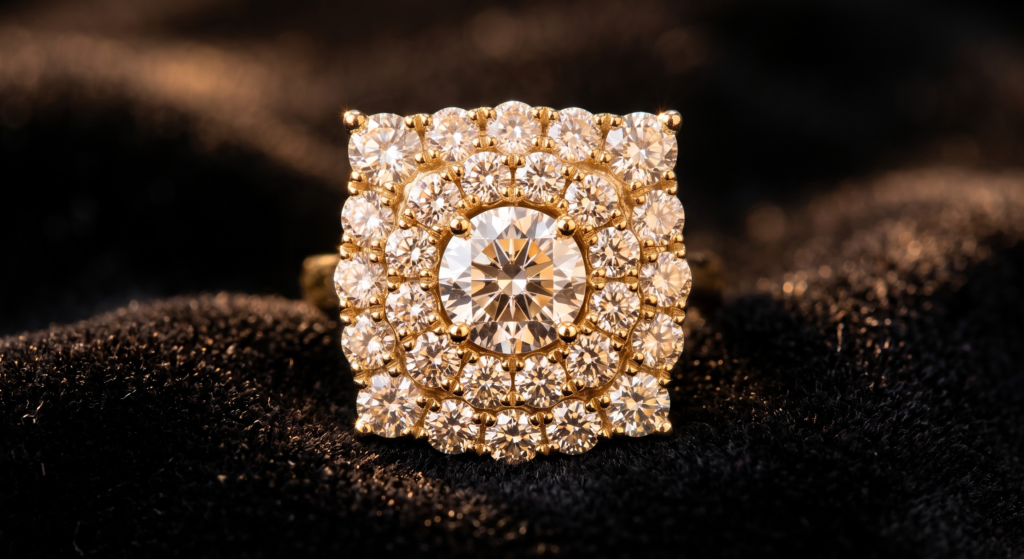
Titan Company Limited (“Titan”) filed Patent Application No. 202041004928 on 4 February 2020, seeking protection for an invention titled “A Jewellery Assembly.” The invention comprises a base member with multiple walls, a segment defined between adjacent walls at an incline, and a central cavity holding one gemstone, surrounded by smaller elongated gemstones at the periphery that together create the visual effect of a single, larger, unified square-shaped stone. According to Titan, this configuration lets jewellers avoid the cost of one large, high-carat diamond by using several smaller stones arranged with precision, addressing a genuine manufacturing and cost problem rather than merely producing an attractive finish. The Controller of Patents & Designs (“Controller”) rejected the application on 6 February 2024, holding that the claims fell under Section 3(l) of the Patents Act, 1970 (“Patents Act”) and were suitable subject matter for a design application rather than a patent. Titan challenged this rejection before the Madras High Court in a civil miscellaneous appeal filed under Section 117A of the Patents Act.
Issues
-
- Whether Titan’s claimed jewellery assembly falls within the exclusion under Section 3(l) of the Patents Act as an aesthetic creation, or discloses patentable technical and structural features.
- Whether the Controller’s rejection order engaged with Titan’s written submissions on the technical problem and solution before refusing the application.
- Whether the impugned order qualifies as a reasoned, speaking order sustainable in appellate review under Section 117A of the Patents Act.
- Whether the definition of design under Section 2(d) of the Designs Act, 2000 (“Designs Act”) was correctly applied to distinguish the claimed invention from a design.
Titan’s Arguments
-
- Contended that the claims disclose structural and technical features, the arrangement of a central gemstone and surrounding elongated gemstones within an inclined-wall base, and not an aesthetic creation excluded under Section 3(l).
- Argued that a technical advancement not obvious to a person skilled in the art satisfies the inventive step requirement, regardless of whether the finished product is visually attractive.
- Contended that functional and constructional features are structural, technical aspects falling within the scope of patent registration, distinct from features judged solely by the eye.
- Submitted that the invention solved a genuine problem of gemstone-setting precision and manufacturing cost, a technical solution rather than a mode or principle of construction excluded from patentability.
- Argued that the Controller’s order fixated on the ornamental appearance of the finished jewellery and disregarded Titan’s detailed written submissions explaining the technical problem, namely reducing cost while achieving the visual effect of a single large gemstone.
Controller’s Arguments
-
- Maintained that the impugned order was consistent with the Patents Act and reflected due application of mind, pointing to specific paragraphs of the order containing a categorical finding.
- Argued that an invention must amount to more than a mere workshop improvement to merit a patent, and that Titan’s claims did not cross this threshold.
- Contended that the invention’s essential character lay in its shape, configuration and arrangement of gemstones judged solely by the eye, placing it squarely within the definition of design rather than a patentable technical solution.
Court’s Analysis and Observations
The Missing Half of a Reasoned Order
The court observed that patent applications carry a limited statutory term, and a significant portion of that term is typically consumed while the application sits before the Controller of Patents & Designs. The court noted that this reality makes it essential for a rejection order to engage with every ground raised in the hearing notice, rather than resting on a single, more convenient finding. Drawing on the reasoning in Adama Makhteshim Ltd. v. The Controller of Patents (C.A. (COMM.IPD-PAT) 167/2022, Delhi High Court, decided 1 May 2023), the court held that an order confined to one objection, while leaving other grounds undiscussed, forces an appellate court to remand the matter rather than examine patentability on the merits, further eroding the patent’s already limited life. The court found that paragraph 14 of the impugned order simply recorded that there was no technical problem and no technical solution, without any engagement with Titan’s written submissions explaining how the gemstone arrangement addressed a manufacturing and cost problem.
Reopening the Patent or Design Question
The court reasoned that the real dispute, whether the invention presented a patent or design question, could not be resolved on a record where the Controller had not tested Titan’s technical claims against the statutory definition of design. The court referred to Section 2(d) of the Designs Act, which confines design to features of shape, configuration, pattern or ornament judged solely by the eye, and which expressly excludes any mode or principle of construction. The court observed that Titan’s claimed structural arrangement, walls, an inclined segment, a central cavity, and peripheral gemstones performing the function of holding a larger gemstone in place, was not self-evidently confined to visual appeal, and that the Controller’s order gave no reasoned basis for treating it as such. The court further observed that a rejection resting on the patent or design boundary demanded more than a bare assertion; it required the Controller to test the applicant’s stated technical problem against the complete record.
No Opportunity, No Sustainable Order
The court stated that fairness required Titan be given an opportunity to address the Controller’s conclusions before a final rejection, particularly where the order failed to discuss submissions already on file. The court opined that the absence of any such engagement, combined with the order’s silence on Titan’s technical contentions, meant the rejection could not be sustained as a speaking order amenable to appellate confirmation.
Findings
In view of the observations and the arguments presented by both the parties, the Madras High Court held that:
-
- The impugned order rejecting Patent Application No. 202041004928 did not engage with Titan’s written submissions on the technical problem and solution claimed in the invention.
- The order was a non-speaking order that failed to address all the grounds raised in the hearing notice, falling short of the standard required for orders passed under Section 15 of the Patents Act.
- The patent or design question could not be resolved on the existing record, since the Controller had not tested Titan’s claims against the definition of design under Section 2(d) of the Designs Act.
- The impugned order dated 6 February 2024 is set aside, and Patent Application No. 202041004928 is remanded to the Controller of Patents & Designs for fresh consideration.
- The Controller is directed to complete the fresh consideration as expeditiously as possible, with no order as to costs.
Case Citation: Titan Company Limited v. The Controller of Patents & Designs, C.M.A.(PT) No. 44 of 2024, High Court of Judicature at Madras, decided on 11 December 2025. Available at http://indiankanoon.org/doc/18822748/
Authored by Gaurav Mishra, Patent Attorney, BananaIP Counsels
