Authors: Kalyan C. Kankanala, BananaIP Counsels; and Anil B. Suraj, IIM, Bangalore.
Introduction
Open source software is today an integral part of almost all businesses, which use it in one way or another, either directly or through the software and services they buy from others (Kshetri, 2025; White et al., 2024). It is estimated that more than 78% of businesses rely on open source software in their daily operations, and it is used by 90% of Fortune Global 500 companies (Kshetri, 2025). One report states that open source was present in 98% of the 947 commercial codebases that were audited between November 2024 and October 2025 (Black Duck, 2026).
Broadly, open source software is based on the principle that the source code of software must be made available for anyone to use, study, modify, and share (Ramos and Pianese, 2026). This is normally accomplished through open source licences, which make the source code available and permit use, study, modification, and distribution, including for commercial purposes, without discriminating against persons or fields of activity (Open Source Initiative, 2024a). Open source licences are broadly of two types, permissive licences and copyleft licences. Permissive licences, such as the MIT and Apache 2.0 licences, give users freedom to use, modify, and distribute the software, with minimum conditions, mainly relating to retention of copyright and licence notices (Kshetri, 2025). Copyleft licences, such as the GNU General Public License, require that original and modified works, when distributed, be also shared under the same licence, so that the source code remains available (Kshetri, 2025).
Over the years, the open source model has also moved beyond software into other areas of research, development, and industry. It has been used to share an open standard for designing computer chips (RISC-V International, n.d.), designs of data centre hardware (Open Compute Project, n.d.), biological materials such as DNA (Kahl et al., 2018), and the data and results of drug discovery research (Årdal and Røttingen, 2012; Boby et al., 2023). Open source-like models have also been applied to research infrastructure through which computing power, data storage, and repositories have been shared with researchers (Linåker et al., 2026; Zenodo, n.d.).
While open source software has been hugely successful, and a large portion of software is developed through this model, applying open source principles to AI technology has given rise to certain complications (Maffulli, 2025; Widder, Whittaker and West, 2024). Though AI may also be considered as primarily software-based (Ramos and Pianese, 2026), it has several aspects, components, or parts that pose difficulties in applying the open source model to it (Liesenfeld and Dingemanse, 2024). Having said that, there are compelling reasons to make AI open. AI systems that are based on open source can be checked by a wider community for errors and bias, and problems in them can be found and fixed by that community, though this may depend on access to expertise and resources (Dey, 2025). Openness can also help research to be reproduced and built upon (Maffulli, 2025), and it can lower the cost of access for researchers, smaller organisations, and developing countries, which in turn promotes competition and innovation (Dey, 2025; Kshetri, 2025).
AI and Its Working System
As it stands today, the meaning of artificial intelligence (AI) is not settled and it is understood differently in different contexts. Over its history of more than 70 years, the term has been used for many different technologies, often more as a marketing label than as a precise technical term (Widder, Whittaker and West, 2024). The EU AI Act defines an AI system as a machine-based system that is designed to operate with varying levels of autonomy, and that infers from the input it receives how to generate outputs such as predictions, content, recommendations, or decisions (European Union, 2024, Article 3(1)).
Broadly, AI systems may be deterministic or non-deterministic. Deterministic AI systems, such as rule-based systems, follow a fixed set of instructions and give the same, predictable output for the same input. The EU AI Act leaves such systems out of its definition of an AI system (European Union, 2024, recital 12). Non-deterministic or probabilistic AI systems learn patterns from large amounts of data and draw inferences from them, and their outputs are not fixed in advance (Widder, Whittaker and West, 2024). The present debate on openness is mainly about non-deterministic AI, and in particular about generative AI, which creates text, images, code, and audio. Examples include ChatGPT, Llama, and DeepSeek.
Non-deterministic AI is generally made in stages. Large amounts of data are first collected, cleaned, and prepared. A base model is then trained from scratch on this data, using a chosen model design, training code, development tools, and very large computing power. This first stage is called pre-training, and it is the most costly stage. The base model is then refined. It is fine-tuned on selected examples, improved through human feedback on its answers, and filtered for safety. It is then tested against benchmarks, documented, and released, either for others to download or through an app or interface. After release, others may adapt it further, for example by fine-tuning it for a local language or a particular field, or by making it smaller so that it can run on less powerful machines (Linåker et al., 2026).
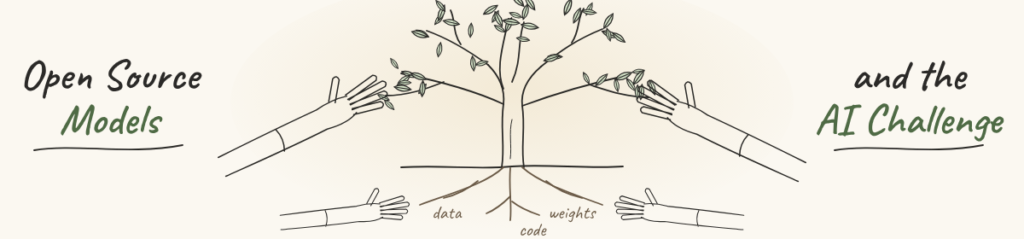
As can be seen, an AI system consists of multiple parts that need to work together, and some of those parts may be open, and others may not be (Robinson, 2026). The first group of parts is the model itself. This includes the architecture, which is the design or structure of the model, and the weights, which are the numbers the model learns during training and which are necessary to run the model (Ramos and Pianese, 2026). The second group is what goes into making the model. This includes the data used for training and testing, and the code used to prepare the data, train the model, and run it. It also includes the training process itself, and the development tools, which are used to build most AI systems. Computing power, in the form of specialised chips, data centres, and energy, is also part of this group, and so are the people who help to label data and rate the model’s answers (Widder, Whittaker and West, 2024). The third group is what surrounds the model. This includes testing materials and documentation, such as benchmarks, model cards, and technical reports, and the product or interface through which people use the model (Linåker et al., 2026; Ramos and Pianese, 2026).
To understand ordinary software, looking at only the source code is sufficient as it largely explains how a program works. With AI, however, the behaviour of a system depends on all of its parts, many of which cannot be understood by looking at the final model alone (Ramos and Pianese, 2026). This raises the question of what it means for AI to be open.
AI as Open Source
Today, open source AI is generally understood as AI that is made available for anyone to use, study, modify, and share, in the same way as open source software (Open Source Initiative, 2024a; 2024b). However, since AI is made up of many parts, what open source AI means depends on which of those parts are expected to be open. The principles of open source software therefore cannot be applied to AI as they are, and there is still no single agreed meaning of open source AI (Kshetri, 2025; Ramos and Pianese, 2026).
The most widely discussed meaning is the Open Source AI Definition 1.0, released by the Open Source Initiative (OSI) in 2024. Under this definition, an AI system is open source if it can be:
- used for any purpose without asking for permission,
- studied to understand how it works,
- modified for any purpose, and
- shared with or without changes.
For these freedoms to be real, three parts of the AI system are expected to be open. The first is information about the training data. This must be detailed enough for a skilled person to build a substantially similar system, and it must cover where the data came from, how it was selected, labelled, and processed, and where publicly available data can be obtained. The second is the complete code used to process the data, train the model, test it, and run it. The third is the model weights and settings. All of these must be made available on terms accepted by the Open Source Initiative. As per the Open Source AI Definition, the training data itself is not required to be released, as it is often protected by copyright and privacy laws, but where it cannot be shared, the developer must disclose its sources, characteristics, and preparation methods, so that others can rebuild the system using similar data (Maffulli, 2025; Open Source Initiative, 2024b).
Compared to OSI’s approach, the EU AI Act takes a different approach with respect to data access. Under the Act, a general-purpose AI model is treated as open if it is released under a free and open source licence that allows access, use, modification, and distribution, and if its weights, information about its architecture, and details about how to use it are also made public. Providers of such open models do not have to prepare technical documentation of the model for the authorities, or give information and documentation to those who build the model into their own AI systems (European Union, 2024, Article 53(1)(a)–(b) and Article 53(2)). This exemption does not apply to open models with systemic risk, which are very capable models that could cause harm on a large scale (European Union, 2024, Article 3(65) and Article 53(2)). For a model to be treated as open under the Act, the training data and training code need not be made open, though all providers, including providers of open models, must publish a summary of the content used for training, and must have a policy to comply with EU copyright law (European Union, 2024, Article 53(1)(c)–(d); Ramos and Pianese, 2026).
In practice, the term open source AI is used even more loosely. Many models described as open are open weight models, where the weights can be downloaded, run, and customised, but the training data and training code are kept closed, and the licence under which the open weights are made available may restrict certain uses (Liesenfeld and Dingemanse, 2024; Widder, Whittaker and West, 2024). Users normally accept such models as open source if they are free to access, have generally unrestrictive licences, and can be customised (Robinson, 2026). Objecting to this approach, researchers argue that openness must be judged across all the parts of an AI system, including code, training data, weights, documentation, scientific papers, and licence terms, and openness must not be limited to a few parts. As it stands today, only a few models are open across most of the parts that constitute AI (Liesenfeld and Dingemanse, 2024; Linåker et al., 2026).
In the context of openness, making only the weights open is not as useful as making the entire chain open. When only the weights are released, others can run the model, use it in their own products, and adapt it substantially for their needs, for example through fine-tuning, without training it again from the beginning. However, without the training data and code, they cannot rebuild the original training process, check where the data came from, or fully examine the biases the model has inherited and the design decisions made in building it. Access to the weights helps in studying the model, but it does not fully explain why the model behaves as it does. As a result, there is dependency on the original developer (Robinson, 2026; Widder, Whittaker and West, 2024). On the other hand, when the entire chain is open, including the data or detailed information about it, the code, the weights, and the documentation, others can study how the system was built, test and verify the claims made about it, fix its problems, and build a similar system of their own (Maffulli, 2025; Ramos and Pianese, 2026). Only then do users enjoy the freedoms to use, study, modify, and share, permissions that open source software has traditionally offered.
Spectrum of AI Openness
In open source software, though rights and flexibilities may vary, openness in the context of source code is largely a binary question. Either the source code is released under an open source licence, or it is not (Open Source Initiative, 2024a; White et al., 2024). In AI, this is not the case. Since an AI system is made up of many parts, each part may be open, partly open, or closed. Openness in AI is therefore not binary. It comes in degrees, along a spectrum. Researchers describe openness in AI as composite, because it is made up of many parts, and gradient, because each of those parts may be open to a different degree (Liesenfeld and Dingemanse, 2024; Widder, Whittaker and West, 2024). However, describing where an AI system sits on this spectrum is different from deciding whether it meets a specific definition, such as the Open Source AI Definition, which remains a yes or no question. A system may be open to different degrees across its parts, and may still either meet or fail that definition (Open Source Initiative, 2024b).
Robinson (2026) offers one way of describing this spectrum, though other researchers may describe it differently. At one end are closed products, which people can only use through the provider’s own product. Next are models that can be accessed only through an interface, so that others can build them into their own products but cannot see inside them. Further along are models that are largely open but whose weights are kept back. Then come open weight models, whose weights can be downloaded and used, but under licences that restrict use. Next are open models released under unrestrictive licences such as the MIT or Apache 2.0 licences, though even these models may not disclose their training data (Robinson, 2026). At the far end are models that are open across the entire chain, including the training data, code, weights, and documentation (Liesenfeld and Dingemanse, 2024; Linåker et al., 2026).
Researchers have proposed different frameworks for measuring where an AI system sits on this spectrum. Liesenfeld and Dingemanse (2024) have proposed a framework that assesses openness across 14 points in three groups:
- what is made available, such as code, data, and weights;
- documentation, such as scientific papers, model cards, and datasheets; and
- access and licensing.
Each point is rated as open, partly open, or closed. Similarly, another framework, the Model Openness Framework, grades AI systems into three classes. The first is Open Model, which covers the architecture, weights, and basic documentation. The second, Open Tooling, adds the code used for training and testing. The third, Open Science, adds the training data and research papers, so that the system can be fully studied and reproduced (White et al., 2024).
Understanding openness as a spectrum is important. When an AI system is simply called open or closed, it can mislead users, because a system may be called open even when only one of its parts, such as the weights, is open (Liesenfeld and Dingemanse, 2024). The spectrum helps users, researchers, and regulators see exactly what is open and what is not. It also shows that different parts of AI can be opened to different degrees, and that a single model of openness may not suit every part of AI technology.
Open Vs Closed AI Models
Both fully open and fully closed AI models have advantages and disadvantages. Neither approach is free of problems, and choosing between them involves trade-offs between transparency, safety, responsibility, and control (Widder, Whittaker and West, 2024; Koch, 2025).
Fully open models allow anyone with the necessary expertise and resources to examine a system, check it for bias and errors, and reproduce the work of others (Liesenfeld and Dingemanse, 2024; Dey, 2025). However, they also carry risks. Once the weights are released, anyone can fine-tune the model for harmful purposes. Open models can be misused for deepfakes, misinformation, automated cyber attacks, and even to provide detailed guidance to enable criminal activities (Dey, 2025; Hong et al., 2025). Harmful or compromised models can also spread quickly through model-sharing platforms before they are detected (Dey, 2025). Releasing training data raises its own problems, as such data often contains copyrighted works and personal information collected without consent, and laws on copyright and privacy may not permit it to be shared (Dey, 2025; Linåker et al., 2026). Responsibility is another concern. Some open AI projects have no central controlling entity, while others are led by companies, foundations, or institutions (Dey, 2025; Linåker et al., 2026). Once an open model is released, it is difficult to track its copies and to identify who is responsible for biased or harmful uses (Dey, 2025). However, this does not remove the responsibilities that providers and deployers have under laws such as the EU AI Act (European Union, 2024, Article 3(3)–(4) and Article 53). Errors and biases in an open model may also be carried into models built from it, unless the problems are identified and corrected (Widder, Whittaker and West, 2024). Further, releasing a model does not remove the need for costly computing power, so the ability to train such models remains limited to a few large companies (Widder, Whittaker and West, 2024).
Fully closed models have their own advantages. The provider controls how the model is used, can take steps to block misuse, can update safeguards, and can protect personal data, though such safeguards can sometimes be bypassed (US AI Safety Institute and UK AI Safety Institute, 2024). It can also keep sensitive innovations away from competitors and adversaries (Koch, 2025). There is also a clear entity that can be approached about biases and misuse, though this does not by itself ensure that it is held responsible (Dey, 2025). However, outsiders cannot inspect the training data, weights, or code of closed models, and must rely on the word of the provider for these (Liesenfeld and Dingemanse, 2024). Under certain circumstances, outsiders may be permitted to test how a closed model behaves, through its interface or through access agreed with the provider, as the AI safety institutes of the United States and the United Kingdom did before one such model was released (US AI Safety Institute and UK AI Safety Institute, 2024). Moreover, research based on closed models can be repeated only as long as the same version of the model remains available, and it becomes difficult to reproduce when providers change or withdraw their models (Liesenfeld and Dingemanse, 2024). Further, without additional disclosure, it is generally not possible to rebuild how a closed model was trained. Closed models can also lead to vendor lock-in and a lack of transparency (Koch, 2025), and they can concentrate power in the hands of a few companies (Widder, Whittaker and West, 2024).
Despite its disadvantages, openness may be the best way forward for AI. First, openness allows public scrutiny and independent auditing, and systems that disclose their training data may be safer for that reason (Liesenfeld and Dingemanse, 2024). Second, it allows technology to be reproduced and built upon, which closed systems permit only to a limited extent (Maffulli, 2025). Third, it lowers barriers for researchers, start-ups, smaller organisations, and developing countries, encourages competition, and most importantly reduces global dependence on a few companies (Dey, 2025; Hong et al., 2025). Fourth, weaknesses in open systems can be found and fixed by a worldwide community that has the expertise and resources to do so (Dey, 2025), and the risks of openness can be reduced through other measures such as tiered access and oversight (Dey, 2025).
Having said that, training an AI model requires very costly computing infrastructure, and questions have been raised about why anyone would invest in it if the resulting model is to be made open. Prior experience, albeit limited, has shown that openness can itself be a reason to invest. Companies may release open models to build an ecosystem around them, as wider use leads to faster improvement of the model (Linåker et al., 2026), and those who fine-tune and extend the model in effect contribute to its development (Widder, Whittaker and West, 2024). Open models also lower the barrier to adoption and expand the market, while revenue may be earned from professional services and paid use of the model built around them (Dodds and Liang, 2026). Further, openness can spread the cost of research and development across a wider community (Hong et al., 2025), and governments may invest in computing infrastructure while universities and businesses work together to improve the models (Kshetri, 2025). For instance, a public supercomputer in France and a supercomputing centre in Poland have been used to train open models (Linåker et al., 2026).
Closing Thoughts
The traditional open source software model cannot be applied to AI as it is. In software, making the source code available is largely enough for anyone to use, study, modify, and share it. In AI, however, this is not enough, because openness depends on the disclosure and availability of many parts, such as the data or information about it, the code, the weights, and the documentation (Ramos and Pianese, 2026). Therefore, any system created for openness in AI must take into account the openness of all the parts required to use, study, modify, and distribute the AI (Open Source Initiative, 2024b).
However, this does not mean that every part must always be fully open. As discussed above, full openness has its own risks, and some parts, such as training data, may not be shared freely because of privacy and copyright concerns. A more practical approach would be to recognise and establish a degree of openness that an AI system must meet to be called open, and this degree may vary based on what has been developed and for what purpose or use. Under such an approach, a partly open system can be clearly distinguished from one that meets the Open Source AI Definition. The proposals made so far reflect this thinking. They range from definitions that expect degrees of openness across the entire chain, to frameworks that measure openness in levels, and to licences designed specifically for AI that set out what is shared and on what terms (Liesenfeld and Dingemanse, 2024; Open Source Initiative, 2024b; White et al., 2024; PyTorch Foundation, 2025).
Such a graded approach, where different parts of AI are opened to different degrees, can keep the core benefits of open source while also managing its risks. Early recognition of this graded approach by regulation can help unlock immense economic value of collaborative AI development, wherein startups, research institutions, and innovators across the world may participate in the making of AI and its tools, in a manner that is responsible and meaningful.
Open source AI is therefore well suited for the equitable and inclusive distribution of AI technology across the world, as open releases can widen access and allow others to adapt AI independently (Dey, 2025). However, as Widder, Whittaker and West (2024) argue, openness alone does not overcome the concentration of computing power, infrastructure, and market access in a few hands. To achieve that, openness must go beyond the release of weights, and extend to even data, computing power, and knowledge being shared through collaboration among communities, researchers, and institutions (Linåker et al., 2026). Only then can AI be truly open, and its benefits be shared by all.
From the Indian perspective, participating in the development of AI by opening up data, building computing capabilities, and using the country’s own strengths would be more beneficial than following a closed approach. India has a large community of developers, with more than 10 million on GitHub in 2023, and has made over 38,000 GPUs available to startups and academic institutions under the IndiaAI Mission (Government of India, 2026; Kshetri, 2025). These capabilities can be used to adapt open models to Indian languages and needs, and to contribute to the progress of AI technology across the world (Kshetri, 2025). More may be achieved by participating in AI development in any capacity than by staying out of it, as staying out could make India dependent on a few providers and leave it with little control over AI technology.
Acknowledgements
We would like to thank Professor Arul Scaria, NLSIU, Mr. Sandeep Hegde, Legal Counsel (Oracle), and Mr. Bhaskar Das, independent consultant, for their valuable comments, which helped us improve this article.
References
Årdal, C. and Røttingen, J.-A. (2012) ‘Open source drug discovery in practice: a case study’, PLoS Neglected Tropical Diseases, 6(9), e1827. doi: 10.1371/journal.pntd.0001827.
Black Duck (2026) 2026 Open Source Security and Risk Analysis report. Available at: source page on blackduck.com (Accessed: 17 October 2026).
Boby, M.L. et al. (2023) ‘Open science discovery of potent noncovalent SARS-CoV-2 main protease inhibitors’, Science, 382(6671), eabo7201. doi: 10.1126/science.abo7201.
Dey, S. (2025) ‘The rise of open source models and implications of democratizing AI’, Computer, 58(8), pp. 92–96. doi: 10.1109/MC.2025.3548824.
Dodds, T. and Liang, C. (2026) ‘Strategic opacity: the paradox of open source AI governance in DeepSeek and OpenAI’, The Information Society, 42(4), pp. 221–240. doi: 10.1080/01972243.2026.2680886.
European Union (2024) Regulation (EU) 2024/1689 of the European Parliament and of the Council of 13 June 2024 laying down harmonised rules on artificial intelligence (Artificial Intelligence Act). Official Journal of the European Union, L, 12 July. Available at: source page on eur-lex.europa.eu (Accessed: 18 October 2026).
Government of India (2026) IndiaAI Mission expands AI ecosystem with affordable compute and startup support. Digital India. Available at: source page on digitalindia.gov.in (Accessed: 18 October 2026).
Hong, S., Ryee, H., Jin, X. and Yang, D. (2025) ‘How organizations choose open-source generative AI under normative uncertainty: the moderating role of exploitative and exploratory behaviors’, Journal of Theoretical and Applied Electronic Commerce Research, 20(3), article 250. doi: 10.3390/jtaer20030250.
Kahl, L., Molloy, J., Patron, N., Matthewman, C., Haseloff, J., Grewal, D., Johnson, R. and Endy, D. (2018) ‘Opening options for material transfer’, Nature Biotechnology, 36(10), pp. 923–927. doi: 10.1038/nbt.4263.
Koch, C. (2025) ‘The role of open source in an AI arms race’, Computer, 58(10), pp. 93–96. doi: 10.1109/MC.2025.3581000.
Kshetri, N. (2025) ‘Economics of open source software and AI models’, Computer, 58(1), pp. 134–141. doi: 10.1109/MC.2024.3488974.
Liesenfeld, A. and Dingemanse, M. (2024) ‘Rethinking open source generative AI: open-washing and the EU AI Act’, in Proceedings of the 2024 ACM Conference on Fairness, Accountability, and Transparency (FAccT ’24), Rio de Janeiro, 3–6 June. New York: Association for Computing Machinery, pp. 1774–1787. doi: 10.1145/3630106.3659005.
Linåker, J., Osborne, C., Ding, J. and Burtenshaw, B. (2026) ‘A cartography of open collaboration in open source AI: mapping practices, motivations, and governance in 14 open large language model projects’, arXiv preprint, arXiv:2509.25397v2. Available at: source page on arxiv.org (Accessed: 11 October 2026).
Maffulli, S. (2025) ‘Why “open source” AI isn’t truly open’, Nature, 640, p. 9. doi: 10.1038/d41586-025-00930-6.
Open Compute Project (n.d.) About. Available at: source page on opencompute.org (Accessed: 18 October 2026).
Open Source Initiative (2024a) The Open Source Definition. Available at: source page on opensource.org (Accessed: 17 October 2026).
Open Source Initiative (2024b) The Open Source AI Definition – 1.0. 28 October. Available at: source page on opensource.org (Accessed: 17 October 2026).
PyTorch Foundation (2025) The open source legacy and AI’s licensing challenge. 22 May. Available at: source page on pytorch.org (Accessed: 17 October 2026).
Ramos, S. and Pianese, F. (2026) ‘Regulating transparency: a critique of the “free and open source AI” definition in the EU AI act’, AI and Ethics, 6, article 317. doi: 10.1007/s43681-026-01177-1.
RISC-V International (n.d.) About RISC-V International. Available at: source page on riscv.org (Accessed: 18 October 2026).
Robinson, N. (2026) ‘Open to open-source AI? Navigating AI model choice in public sector agencies’, Government Information Quarterly, 43, article 102133. doi: 10.1016/j.giq.2026.102133.
US AI Safety Institute and UK AI Safety Institute (2024) US AISI and UK AISI joint pre-deployment test: Anthropic’s Claude 3.5 Sonnet (October 2024 release). National Institute of Standards and Technology, 19 November. Available at: PDF on nist.gov (Accessed: 25 October 2026).
White, M., Haddad, I., Osborne, C., Liu Yanglet, X.-Y., Abdelmonsef, A. and Varghese, S.M. (2024) ‘The Model Openness Framework: promoting completeness and openness for reproducibility, transparency, and usability in artificial intelligence’, arXiv preprint, arXiv:2403.13784v4. Available at: source page on arxiv.org (Accessed: 17 October 2026).
Widder, D.G., Whittaker, M. and West, S.M. (2024) ‘Why “open” AI systems are actually closed, and why this matters’, Nature, 635, pp. 827–833. doi: 10.1038/s41586-024-08141-1.
Zenodo (n.d.) Infrastructure. Available at: source page on about.zenodo.org (Accessed: 18 October 2026).
Disclaimer regarding use of AI
Artificial intelligence tools were used in preparing this article to assist with summarising the source material, refining the text under the authors’ direction, and checking references. The authors have reviewed, revised, and approved the entire content, and take full responsibility for the arguments, analysis, and conclusions in the article.
